
I don’t make a single name 5% of my book lightly. When I size something that large, it’s because I think the market is mispricing not a quarter or a catalyst, but the entire business model. That’s the case I want to lay out here.
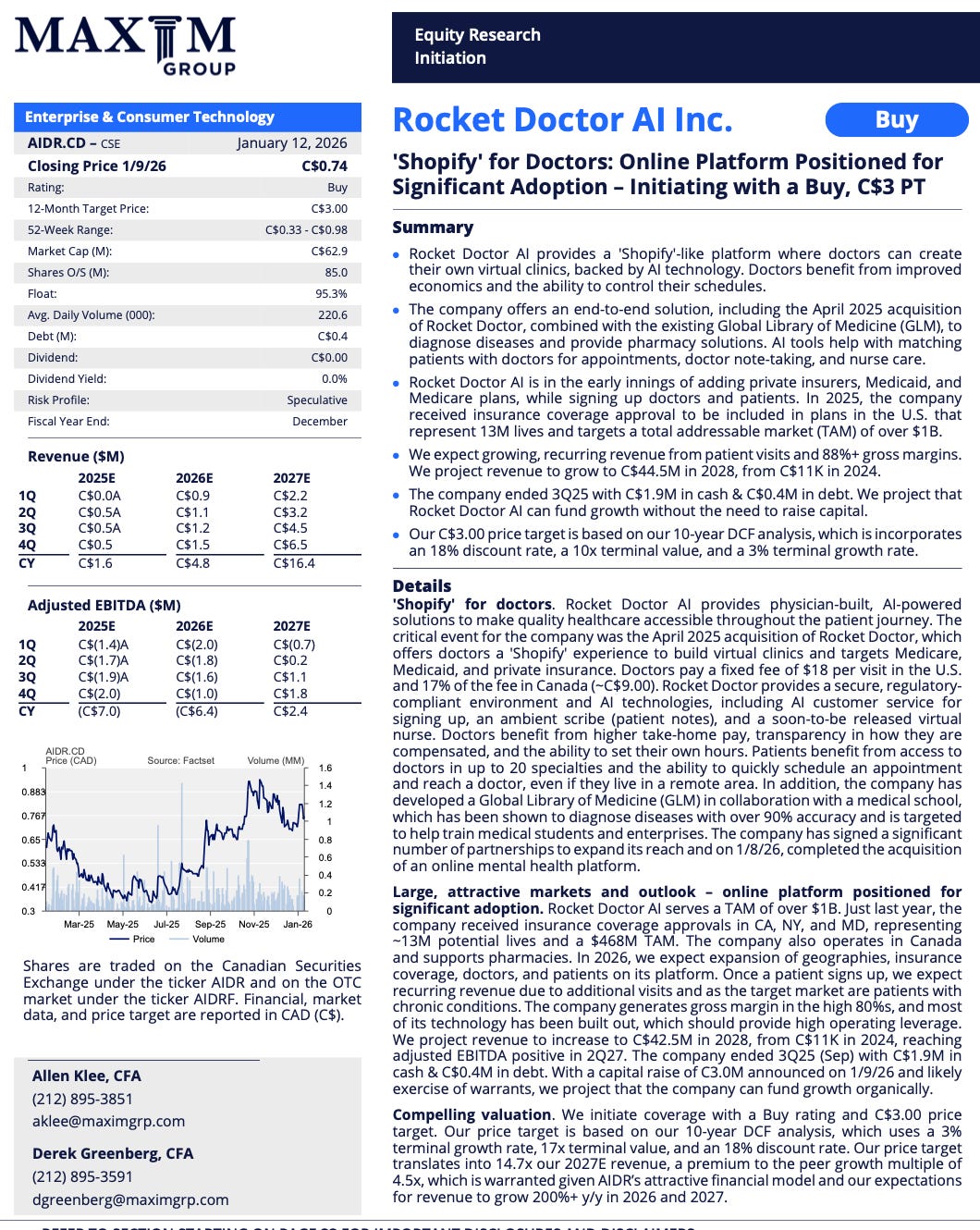
Rocket Doctor AI is a roughly C$60M market-cap, Canadian-listed micro-cap that most people have never heard of. It trades around C$0.62 as I write this. Maxim Group initiated coverage in January with a Buy and a C$3.00 target. Fundamental Research Corp carries a Buy with a C$1.86 fair value. So two independent shops see somewhere between 3x and 5x upside from here. That gap alone got my attention. What kept it was the question of why the gap exists and why I think it closes.
Let me start with the framing that made this click for me.
The Shopify analogy is the whole thesis
When Shopify launched, it didn’t try to outcompete merchants. It gave every merchant the infrastructure, storefront, payments, inventory, and shipping to run their own business, and took a cut of every transaction. The merchant kept their independence and their brand; Shopify monetized the rails beneath them all. The more merchants joined, the more valuable the network became, and the better the unit economics got.
Rocket Doctor is building the same thing for physicians. A doctor signs up, sets their own hours, and runs their own virtual (or hybrid) practice on top of Rocket Doctor’s stack: a HIPAA-compliant EMR, AI tools that pre-collect patient history and draft visit notes, smart patient-to-doctor matching, translation in 200+ languages, lab and imaging ordering, and, critically, the billing and payer-credentialing plumbing that doctors hate dealing with. The doctor is paid per visit rather than a flat salary. Rocket Doctor charges $18 per visit in the U.S. and ~17% of the visit fee (~C$9) in Canada.
This is not a coincidental comparison. It’s literally how Maxim framed their initiation, the most important event in the company’s history, in their words, was the April 2025 acquisition of Rocket Doctor, which gave the company a “Shopify” experience for doctors to sign up and treat patients virtually.
Here’s why the analogy matters for the stock, not just the pitch: a platform that captures revenue at the point of visit has fundamentally different economics than a SaaS company selling per-seat software. Rocket Doctor isn’t licensing software and hoping doctors use it. It sits in the transaction. Every visit to the platform is revenue. And because the technology is largely already in place, almost every incremental visit flows through to the bottom line. Gross margins were 84% in the latest quarter, well above the ~53% average FRC cites for the healthcare-tech sector.
That’s the engine. Now the fuel.
What I’m actually buying: compounding payer infrastructure
The thing that separates Rocket Doctor from yet another telehealth app is the U.S. payer network it has quietly been assembling. In American healthcare, the hard, slow, defensible work is getting “in-network” — i.e., credentialed and contracted with insurers so that visits get reimbursed. It’s a grind: payer-by-payer, state-by-state, full of paperwork and waiting. But once you’ve done it, it’s a moat. New entrants have to redo the entire slog.
Over the last several months, Rocket Doctor has been racking up these agreements at a pace that, for a company this size, is genuinely unusual:
Through 2025, it secured acceptance for commercial insurance, Medicare, and Medicaid across New York, California, and Maryland.
By October 2025, its doctors were in-network with six major insurers across Medicare Advantage, commercial, and Medicaid managed care.
In April 2026, it expanded Maryland access by ~250,000 additional members, bringing its Maryland reach to ~3.2 million covered lives.
As of FRC’s latest update, the network spans ~21 million individuals across ~20 insurers/payers in the U.S.
Read that last number again. ~21 million covered lives. For a C$60M company. Each of those lives is a potential patient who can see a Rocket Doctor physician with the visit reimbursed by their insurer, no out-of-pocket friction. That is the asset I’m underwriting. Not this quarter’s revenue. The network.
And the network compounds in two directions at once. More covered lives attract more doctors (more potential patients to see). More doctors attract more covered lives and let the company credential into more plans. Classic two-sided network effect, the same flywheel that made Shopify, and the marketplaces before it, so hard to dislodge once they got going.
Diagnostic AI, not administrative AI
One more distinction that’s central to why I rate this above the average “AI healthcare” name. Much healthcare AI is administrative, automating billing, scheduling, and paperwork. Useful, real market (McKinsey pegs U.S. healthcare admin at ~25% of spend, north of $1T/year), but it’s a cost-reduction story.
Rocket Doctor’s AI sits at the care-delivery layer. Its Global Library of Medicine (GLM) is a proprietary, clinically grounded model built to support diagnosis, with, per Maxim, a high degree of accuracy and a low hallucination rate due to the clinical data it’s trained on. Combined with ambient scribing, AI history-taking, and an “AI nurse” in development, the point is to multiply each clinician’s throughput. A doctor who spends less time on notes and history can see more patients. More patients per doctor means more $18 visits flowing across the same fixed cost base.
Diagnostic, throughput-multiplying AI has more operating leverage than administrative AI, because it directly expands the network's revenue-generating capacity rather than just trimming overhead. That’s the kind of AI I want exposure to in a platform business.
The proof points are already on the board
This isn’t a pre-revenue science project. The Canadian operation has been live since 2020 and gives a real-world read on whether the model works:
Rocket Doctor–affiliated physicians have treated 360,000+ patients in Ontario since 2020.
In 2024, physicians on the platform saw 62,648 patients, up 63% from 38,378 in 2023.
A virtually-enabled ER program at Georgian Bay General Hospital connected 3,000+ patients with physicians, 97.5% managed virtually, only 1% redirected to the ER, saving the hospital an estimated C$1.4M over ~2.5 years.
In Alberta, 12,000 patients were treated over a three-month period, and 98%+ resolved without in-person care.
Patients get faster access and no surprise bills. Doctors get better take-home pay and control of their schedule. Hospitals save money on diverted ER visits. When every side of a marketplace is genuinely better off, adoption tends to take care of itself.
Where this leaves us going into Part 2
So that’s the what and the why: a Shopify-style platform sitting in the doctor-visit transaction, monetizing every visit at 85% gross margin, compounding a hard-to-replicate U.S. payer network now spanning ~21M covered lives, with diagnostic AI that multiplies clinician throughput and a working, multi-year proof of concept in Canada.
In Part 2, I’ll get into the numbers that actually justify a 5% position: what Maxim and FRC are modeling (revenue going from ~C$1.6M in 2025 toward C$40M+ by 2028 on their estimates), how the C$3.00 and C$1.86 valuations are built, the real risks (dilution, marketing spend, competition, micro-cap liquidity), and the near-term catalysts I’m watching, including the June 3 town hall and the U.S. growth strategy management is about to lay out.
For now, the one-line version of why I sized this at 5%: the market is pricing Rocket Doctor as a tiny Canadian telehealth app. I think I’m buying the early innings of payer-network infrastructure for American medicine.
Disclosure: I hold a long position in Rocket Doctor AI (OTC: AIRDF). This is not financial advice. Micro-cap stocks are speculative and can be highly volatile; both analyst shops rate this a “speculative” risk profile. Do your own research. NFA, DYOR.